
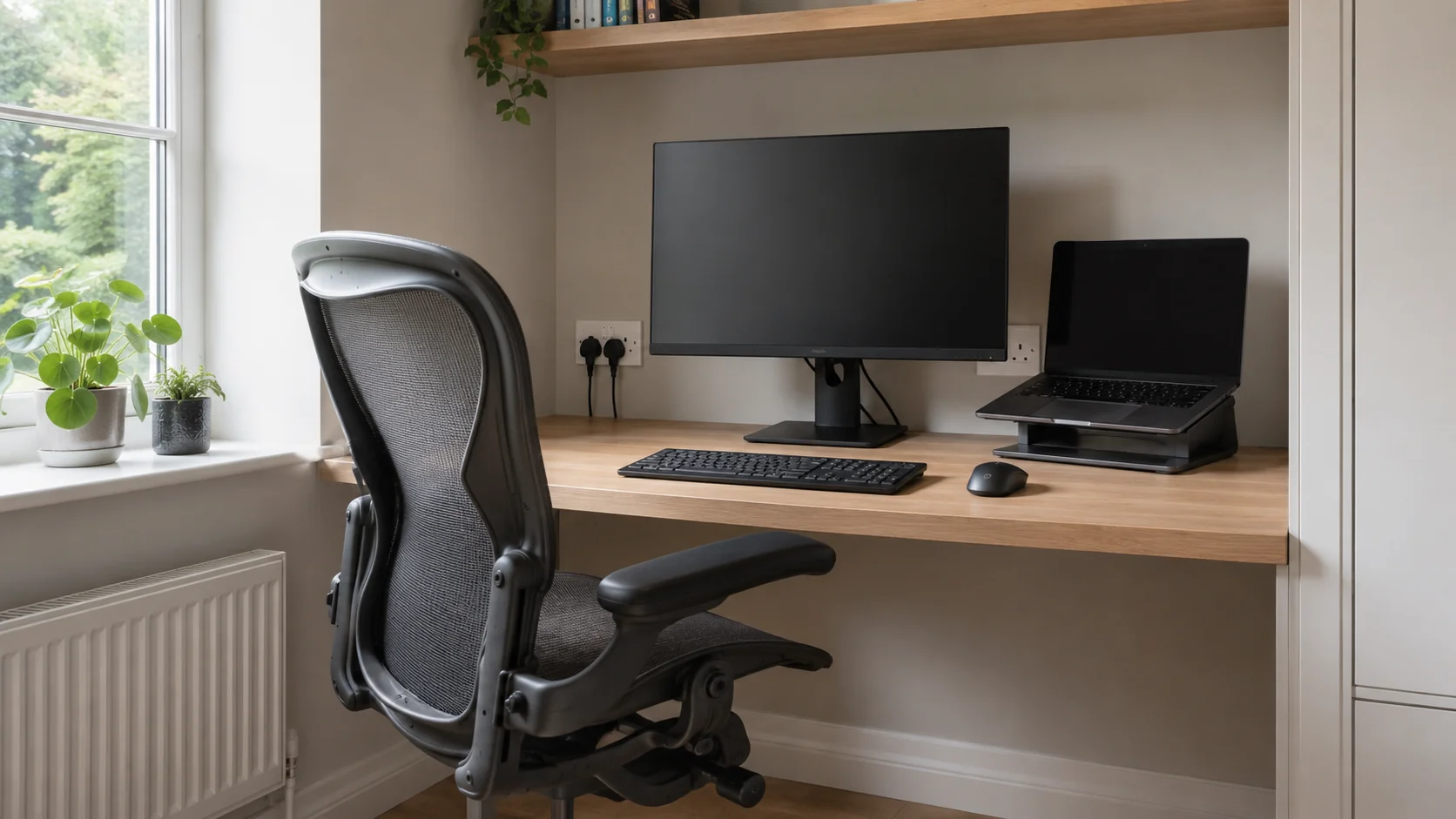
A working from home risk assessment is a structured examination of the hazards faced by workers carrying out their work from home, and a decision about the controls and equipment needed to keep them safe. The duty applies to anyone working from home, whether full-time, hybrid or occasionally, and it has been part of UK health and safety law for far longer than the post-pandemic shift in working patterns.
In Great Britain, the general framework includes the Health and Safety at Work etc. Act 1974, the Management Regulations 1999 and, for relevant users, the DSE Regulations 1992. Northern Ireland has separate corresponding legislation. An employer’s responsibilities do not transfer to a worker simply because they work from home.
This page covers what employers need to assess for home and hybrid workers, the boundaries of the duty, and the practical approach most employers take.
Why home working still requires assessment
Employers in Great Britain retain health and safety responsibilities for their home workers. The Health and Safety at Work etc. Act has a defined territorial scope; it is not a rule that automatically applies everywhere in the world. Overseas working requires consideration of the relevant jurisdictions.
What does change is the practical execution. The employer can't walk through a home workstation in the same way they can walk through an office. They don't control the building, the furniture or the environment. They can't unilaterally redesign the worker's home. These are real constraints, but they don't remove the duty — they shape how it's met.
The HSE has been clear in its guidance that the duty applies to home workers and to hybrid workers, that the assessment can usually be carried out using a structured self-assessment supported by employer review, and that the employer remains responsible for the outcome.
The legal framework
Several pieces of legislation interact for home working.
The general workplace risk assessment under regulation 3 of the Management of Health and Safety at Work Regulations 1999 applies. The home workstation is a workplace for the duration of the work, and the foreseeable risks have to be assessed.
The Display Screen Equipment Regulations 1992 — as amended by the Health and Safety (Miscellaneous Amendments) Regulations 2002 — apply to home DSE users. The DSE assessment requirement covers home workstations as fully as office ones.
Employees in Great Britain can make a statutory request for flexible working from their first day of employment. This is a right to request, not an automatic entitlement to work from home. Employers must consider the request under the applicable employment-law process.
The Equality Act 2010 applies as it would in any workplace. Workers with disabilities may be entitled to reasonable adjustments to their home workstation under the same framework that would apply to an office workstation.
Self-assessment vs employer assessment

The pragmatic approach most UK employers take is a two-step process.
The worker completes a structured self-assessment of their home workstation. This typically uses a checklist covering the chair, desk, screen, keyboard, lighting, environment, electrical safety, fire safety, and any specific concerns the worker has. The HSE publishes a DSE self-assessment checklist that's widely used as the basis for tailored employer versions.
The employer (or a competent reviewer on the employer's behalf) reviews the self-assessment, identifies any concerns, and follows up where issues are identified. The follow-up might be a remote video call, a request for photographs, or in some cases an in-home visit by an ergonomics specialist.
Self-assessment with employer review can be a proportionate method. The employer must ensure that it identifies relevant risks and that necessary action is taken; the existence of a checklist and review record does not itself establish compliance.
The self-assessment shouldn't be treated as the end of the process. The worker may not know what to flag; the employer's review is what turns a checklist into an assessment.
DSE for home workers
For office-based home workers, the DSE risk assessment is usually the largest single component of the home working duty. The standard issues — chair height and support, screen height and distance, keyboard position, lighting, breaks — apply as much at home as in the office.
Where the assessment identifies a need for DSE equipment or adjustments, the employer must ensure they are provided without charging the worker. Needs may include a suitable chair, screen or separate input devices, depending on the workstation and task.
The duty does not automatically require an employer to pay for every home-office expense. It does require the necessary health and safety measures; a policy cannot shift the cost of those measures to the worker.
Mental health and isolation
Home working can introduce or worsen stress risks, including isolation, unsuitable workload, blurred working hours and difficulty accessing support. These risks are not exclusive to home work and should be assessed for the actual person and working arrangements.
These risks sit within the stress risk assessment duty and within the HSE's Working Minds framework. Specific measures for home workers include structured contact patterns, defined working hours, manager training in recognising and supporting remote staff, attention to workload calibration, and explicit permission for workers to maintain boundaries between work and personal time.
Some home workers work without direct supervision or close contact with colleagues. Consider communication, support and emergency arrangements appropriate to the work, rather than assuming that every home worker has identical lone-working risks.
Equipment, fire and electrical safety
The home workstation is a workplace under UK law, but the home itself remains the worker's domestic premises. The interaction between these is sometimes awkward.
Electrical safety
Work equipment must be safe and maintained appropriately. Electrical checks and any testing should reflect the equipment, use and risks; annual portable appliance testing is not a universal legal requirement. Give workers guidance on visible damage and how to report concerns.
Fire safety
In England and Wales, the Fire Safety Order generally excludes domestic premises occupied as a private dwelling. Employers should still assess fire risks arising from work activities or equipment. Scotland and Northern Ireland have separate fire safety legislation.
Equipment
Where the employer supplies equipment for home use, ongoing maintenance and replacement remain the employer's responsibility. Where the worker uses their own equipment, the assessment should consider whether that's safe and suitable for the work.
Children and pets
This is rarely covered in templates but matters in practice. Trailing cables to a workstation in a family home can be a hazard to a toddler or a pet that wouldn't exist in an office. The assessment should consider the realistic home environment, not a stylised office-at-home.
Hybrid workers and two workstations
For hybrid workers — those who split time between home and a workplace — the duty covers both workstations.
A worker who spends two days a week at home and three in the office has two workplaces, both of which need to satisfy the H&S duty. The office workstation is typically a controlled, standardised environment. The home workstation needs its own assessment using the self-assessment-and-review process.
A temporary workstation can be suitable or unsuitable depending on its equipment, arrangement and use. Assess the actual setup and provide necessary adjustments. Reduced screen time does not automatically make an otherwise unsafe arrangement acceptable.
Review triggers
Review of the home working assessment is required when the working pattern changes (a shift from occasional home working to regular home working, or vice versa), when the worker reports discomfort, when significant equipment changes, or when the home circumstances change (a move, a substantial renovation, a change in household composition that affects the working environment).
Choose any scheduled review according to the work and risks. There is no universal annual interval; changes or concerns should trigger action without waiting for a scheduled review.
Where this connects in the cluster
Working from home risk assessment sits at the intersection of DSE, stress, lone working and the general workplace assessment under regulation 3. For most office-based home workers, the DSE element is the bulk of the assessment; the stress and lone working dimensions need explicit consideration alongside.
For employers with significant home or hybrid working populations, building competence in home working assessment is a sensible investment. Formal Risk Assessment Training covers the general method that underpins the home working duty.
Frequently asked questions
Does my employer have to assess my home workstation?
For home work within the applicable health and safety framework, the employer must assess relevant risks. A structured self-assessment followed by employer review and necessary action can be appropriate. The method must suit the work and individual needs.
Who pays for home working equipment?
If the assessment identifies equipment needed to meet health and safety duties, the employer must provide it without charging the worker. This does not mean every home-office cost must be paid, but necessary safety equipment cannot be made conditional on an employee contribution.
Do hybrid workers need two assessments?
Both home and workplace arrangements must be covered. The law does not require two separate forms; assess the risks and controls at each workstation.
What about my home Wi-Fi, fire safety, and other home conditions?
Assess risks arising from the work, equipment and workstation rather than taking general control of the worker’s home. In England and Wales, a private dwelling is generally outside the Fire Safety Order; this does not remove the need to manage work-related fire or electrical risks.
Has the duty changed since the pandemic?
Home workers were covered by health and safety duties before the pandemic. The DSE duty was not first extended to homes by the 2002 amendment. Current HSE guidance explains how employers should assess and manage home and hybrid work.
Related guides
- How often should a risk assessment be reviewed?
- DSE risk assessment: display screen equipment explained
- Lone working risk assessment: keeping solo workers safe
Sources & references
- HSE — Managing home workers’ health and safety
- HSE — Home workers: equipment and safety
- HSE — Display screen equipment at home
- GOV.UK — Flexible working
- HSE — Portable appliance testing
- Home Office — Fire safety responsibilities
Make sure your managers and team are trained to carry out clear, defensible risk assessments.
Explore the Risk Assessment Training course →
Mark writes about workplace health & safety, risk assessment and accredited online training for Risk Assessment Training, part of Online CPD Academy.