
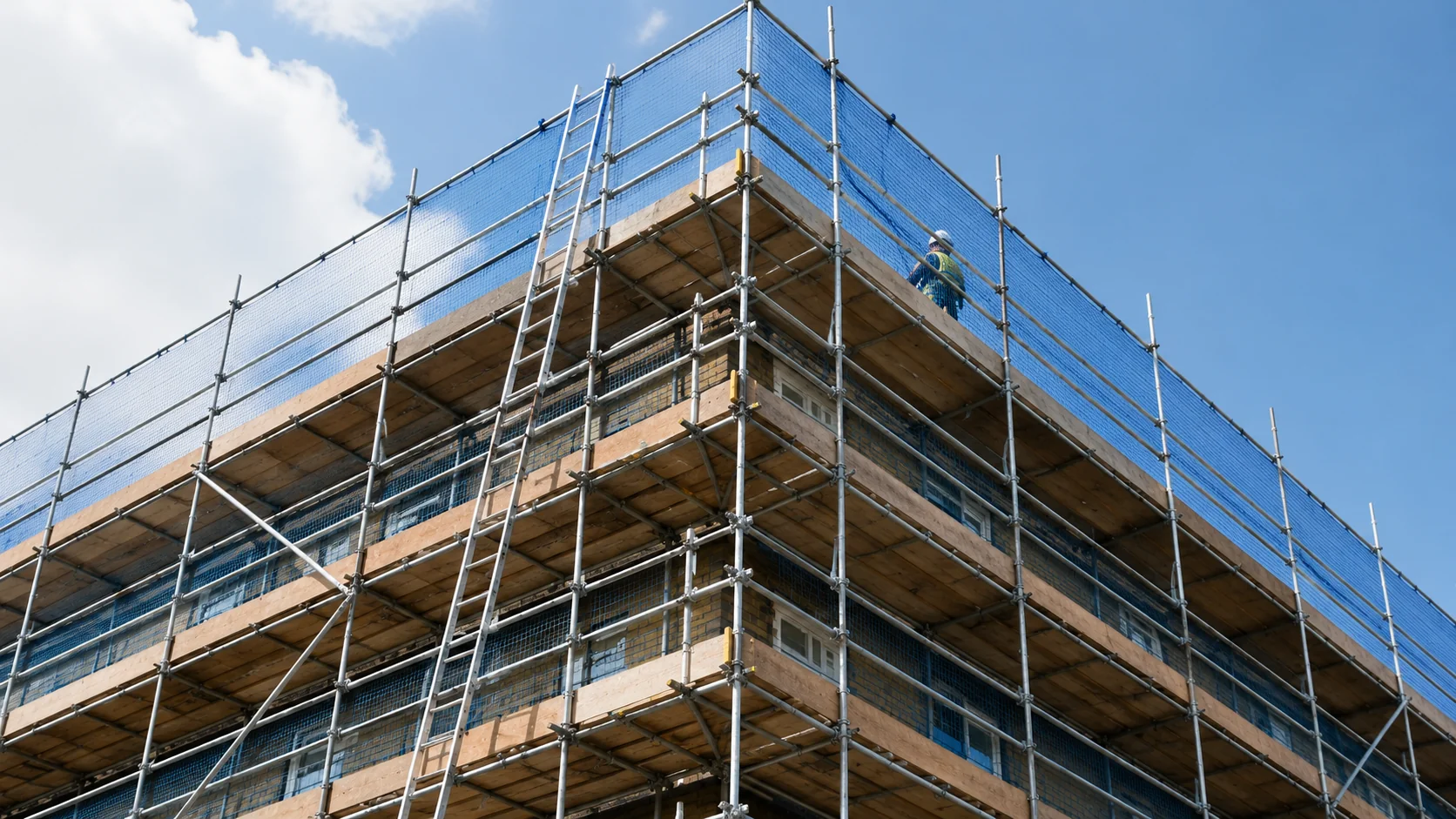
A working at height risk assessment examines work where a fall could cause injury. The Work at Height Regulations 2005 apply in Great Britain; Northern Ireland has separate regulations. Relevant activities include construction, maintenance, cleaning and access to storage, including work at or below ground level.
HSE provisionally recorded 31 worker deaths from falls from height in Great Britain in 2025/26, out of 126 fatal injuries to workers. Falls from height were the largest accident-kind category. This page explains the assessment, control hierarchy and planning needed for work at height.
What "work at height" means in UK law
The 2005 regulations define work at height as work in any place where, if there were no precautions in place, a person could fall a distance liable to cause personal injury. That includes work at, above or below ground level, work involving access to or egress from a place of work, and work involving falling through a fragile surface.
There is no general minimum height: precautions are needed wherever a fall could cause personal injury. A fall of less than two metres can therefore be covered. However, specific two-metre provisions still exist, including the inspection requirement for certain construction working platforms; they are not a general exemption for lower work.
The duty also covers work where someone could fall through a surface, not just off an edge. Fragile rooflights, weakened floor sections and similar features are covered specifically by regulation 9.
The strict hierarchy: avoid, prevent, mitigate

Regulation 6 requires employers to follow the hierarchy below. It complements the general principles of prevention in the Management Regulations.
First — avoid working at height where it is reasonably practicable to do so
Can the work be done from the ground? Can the equipment be designed so maintenance is done at ground level? Can prefabrication eliminate the need for at-height assembly? Avoidance is the strongest control because it removes the hazard entirely.
Second — where work at height cannot be avoided, prevent falls
Use an existing safe place of work or suitable equipment that prevents falls, such as properly guarded scaffolds, towers or mobile elevating work platforms. Select equipment for the task and maintain its protective features.
Third — where the risk of a fall cannot be prevented, mitigate the consequences of a fall
Provide work equipment that minimises the distance and consequences of a fall (a fall arrest system, a safety net, an air bag), and provide training and instruction.
The order is mandatory. An assessor reaching for personal fall arrest equipment (harnesses) before considering collective fall prevention (scaffolds, MEWPs) has inverted the hierarchy. Personal protection comes last because it only protects the wearer, depends on correct fit and use, requires rescue arrangements, and doesn't address the underlying hazard.
Collective versus personal protection
Within the hierarchy, the regulations also prefer collective protection over personal protection. A scaffold that prevents anyone falling off is preferred to a system that catches one worker when they fall. Edge protection that protects everyone on the roof is preferred to a harness worn by one operative.
The preference exists because collective measures work whether or not the worker has remembered to clip on, whether or not their PPE has been inspected, and whether or not they are using it correctly. Personal fall protection works only if all of those conditions are met for every worker, every time, throughout the task.
A persistent failure mode in UK construction is the use of harnesses where collective protection would have been reasonably practicable. Where harnesses are used, the assessment should justify why collective protection wasn't reasonable and document the rescue plan, the inspection regime and the training.
Fragile surfaces

Regulation 9 of the 2005 regulations covers fragile surfaces specifically. A surface is fragile if it would not safely support the weight of a person — typically rooflights, asbestos-cement roofs, weakened decking, certain industrial roofing systems.
Fragile rooflights and roofing can expose workers to fatal falls. Identify fragile areas before work, consider avoiding access and plan effective protection and supervision rather than relying on a worker to recognise the danger while on the roof.
The regulations require that no one passes across or near or works on, from or near a fragile surface unless that's the only reasonably practicable way to carry out the work. Where work near a fragile surface is unavoidable, suitable platforms, coverings or fall protection must be in place, and prominent warnings of the danger must be displayed at the approach.
Falling objects
Regulation 10 covers the hazard of objects falling onto people below. Where work at height could result in objects falling, suitable measures must be taken to prevent injury: securing materials, providing toe boards, using netting or covered scaffolds, establishing exclusion zones.
This duty is often overlooked in assessments that focus heavily on the falling worker and not enough on the people below them. On any construction site, the people walking past at street level are at risk from objects dropped from above; the assessment has to address both directions.
Ladders, towers and Schedule 6

Ladders remain legitimate equipment for work at height, despite a persistent industry myth that "ladders are banned" under the 2005 regulations. They are not banned. The regulations require a risk-based decision about whether a ladder is suitable for the task.
A ladder is suitable only where the assessment shows that safer equipment is not justified because the risk is low and the work is short, or because of existing features that cannot be altered. Use suitable equipment on a firm base. Leaning ladders normally need the 1-in-4 angle and effective securing; footing is a last resort when other securing methods cannot be used.
The right way to read Schedule 6 is as the conditions that justify using a ladder rather than more substantial equipment. Where a job can reasonably be done from a tower scaffold or a MEWP, those should be preferred. Where the task is brief, the height is modest, and the worker can maintain three points of contact, a ladder may be the proportionate choice.
Tower scaffolds must be erected, altered, dismantled and used by people with appropriate competence. PASMA provides a recognised training route, but the regulations do not prescribe that particular certificate for every tower task.
Mobile elevating work platforms can provide suitable access for many tasks. Operators need appropriate training and familiarisation with the machine and its controls. IPAF training is one recognised route, rather than the name of a statutory qualification.
Rescue planning
Planning for work at height must include emergencies and rescue. Where a fall could leave someone suspended in personal fall protection, plan a suitable means of prompt rescue before the work begins.
A person suspended after a fall can become seriously unwell and may be unable to rescue themselves. The outcome and timing vary, so do not rely on a supposed safe suspension period. Plan rescue equipment, trained personnel and first-aid arrangements appropriate to the work.
The rescue plan should identify how a suspended worker would be retrieved, by whom, with what equipment, within what time, and what backup arrangements exist if the primary rescue can't be carried out. "Call the fire brigade" is not, on its own, a rescue plan — fire and rescue services are willing partners, but their arrival time may not match the urgency of the rescue.
A working at height assessment that includes harness use without a rescue plan is incomplete. An assessment that includes harness use with a documented rescue plan, rescue equipment on site, and trained rescuers present is the right standard.
Training and competence
The 2005 regulations require that work at height is planned and supervised by a competent person. Workers carrying out the work must have the necessary skills, knowledge and training for the equipment and method in use.
Training and experience must suit the equipment and work. PASMA, IPAF and CISRS are examples of recognised industry routes. NASC TG 20 addresses tube-and-fitting scaffold configurations and design, while SG 4 concerns preventing falls during scaffolding work; neither replaces task-specific planning or competence.
For the assessor of the overall work, the competence required is broader: understanding of the regulations, the hierarchy of control, the available equipment options, the rescue planning duty, and the specific hazards of the work being assessed.
Where this connects in the cluster
A method statement can explain the safe sequence, access, supervision and emergency arrangements alongside the assessment. “RAMS” is not a universally prescribed statutory document. Building maintenance may fall within the CDM construction-work definition, so check the activity rather than assuming routine maintenance is exempt.
Height work can involve additional hazards requiring separate controls. COSHH may apply to hazardous substances; work with lead has its own Control of Lead at Work Regulations. Consider young workers and pregnancy where relevant, alongside the general assessment and fall-prevention hierarchy.
For employers with regular working at height activity — construction, building maintenance, roofing, telecoms, scaffolding — competence in working at height assessment is one of the highest-leverage areas of safety management. Formal Risk Assessment Training covers the general method that underpins working at height assessment; equipment-specific certification (PASMA, IPAF, CISRS) layers on top.
Frequently asked questions
At what height does the Work at Height Regulations 2005 apply?
In Great Britain there is no general minimum height: the regulations cover work where a fall could cause personal injury. Specific provisions, including certain construction-platform inspections, still use a two-metre threshold; that does not exempt lower work from assessment and precautions.
Are ladders allowed under the Work at Height Regulations?
Yes. Ladders are not banned and remain legitimate equipment for many short-duration tasks involving low risk. Schedule 6 of the regulations sets out the conditions under which ladder use is suitable. The right question is whether a ladder is the proportionate choice for the specific task, not whether ladders are permitted in principle.
What is the hierarchy of fall protection?
Under the 2005 regulations: first, avoid work at height where reasonably practicable; second, prevent falls by using a safe workplace or work equipment that prevents falls; third, mitigate fall consequences with equipment like fall arrest systems and netting. Collective protection is preferred over personal protection within the hierarchy.
Who can carry out a working at height risk assessment?
Someone with competence appropriate to the work, equipment and risks. Relevant training, knowledge, experience and supervision matter. A certificate alone does not establish competence for every assessment; complex work may need specialist input.
Is the 2 metre rule still law in the UK?
There is no general two-metre threshold below which work is exempt from precautions. Some specific duties still use two metres, including inspection of certain construction working platforms. Assess any work where a fall could cause injury.
Do I need a rescue plan if my workers use harnesses?
Yes. Planning must include emergencies and rescue. Where fall protection could leave a worker suspended, arrange a suitable means of prompt rescue, with the necessary people, equipment and training. Relying only on the emergency services is not an adequate plan.
Related guides
- Risk assessment: the HSE's five steps explained
- RAMS: risk assessment and method statement
- How often should a risk assessment be reviewed?
Sources & references
- HSE — Work at height frequently asked questions
- Work at Height Regulations 2005
- HSE — When and how to use ladders safely
- HSE — Fatal injuries at work, 2025/26
- HSE — Construction and CDM duties
Make sure your team is trained to carry out clear, defensible risk assessments.
Explore the Risk Assessment Training course →
Mark writes about workplace health & safety, risk assessment and accredited online training for Risk Assessment Training, part of Online CPD Academy.