

RAMS stands for Risk Assessment and Method Statement. Construction projects often use this format to explain hazards, controls and the planned sequence of work. Contractual document requirements vary, and should be distinguished from the legal duties to assess, plan and manage the work safely.
There is no universal statutory requirement for a combined document called “RAMS”. In Great Britain, risk assessment and CDM duties apply as relevant, and some activities have specific written planning requirements. A method statement can help communicate the safe system of work; its format does not by itself establish compliance.
Risk assessment vs method statement
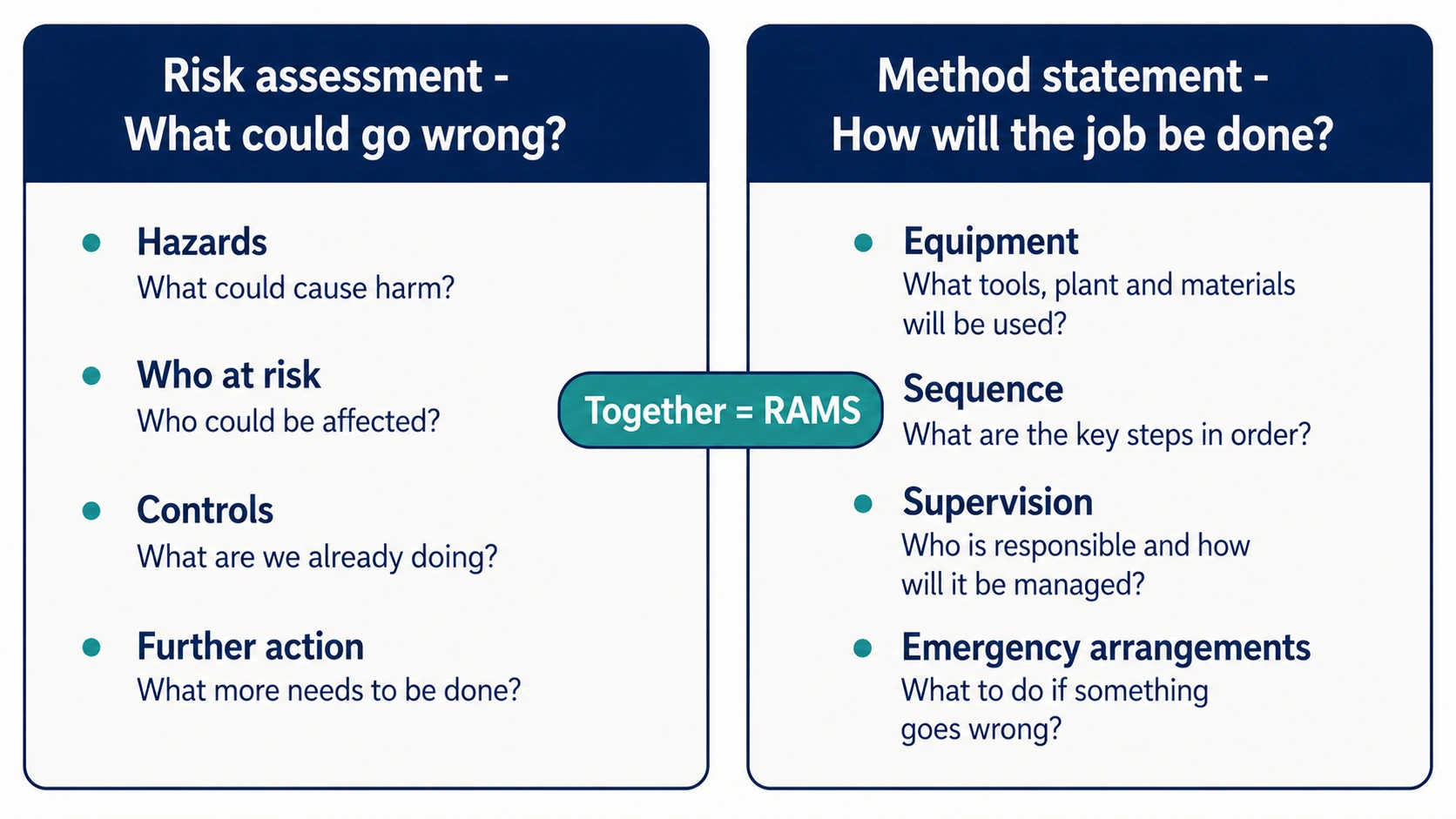
A risk assessment answers what could go wrong. It identifies the hazards on the job, who could be harmed, the controls that will be in place, and any further action needed before work can start. The structure follows the five-step method we cover on our risk assessment process page.
A method statement answers how the job will be done so it doesn’t go wrong. It’s a step-by-step description of the work — equipment, sequence, supervision, emergency arrangements — written in enough detail that a competent worker can follow it without having to invent the method from scratch.
The two documents reference each other. The risk assessment identifies that working at height on a fragile roof is a hazard. The method statement says how the access will be set up, what edge protection will be used, who will check it, what the team will do if the weather changes, and how a rescue would be organised if someone fell. The risk assessment establishes the what; the method statement establishes the how.
The risk assessment and method should be consistent and easy to use. They may be combined or separate, provided relevant findings and working arrangements are clearly communicated and acted on.
When you need a RAMS
Not every construction task requires a formal RAMS pack. A general risk assessment for routine office work doesn’t need a method statement. A site-induction toolbox talk for unloading materials may not.
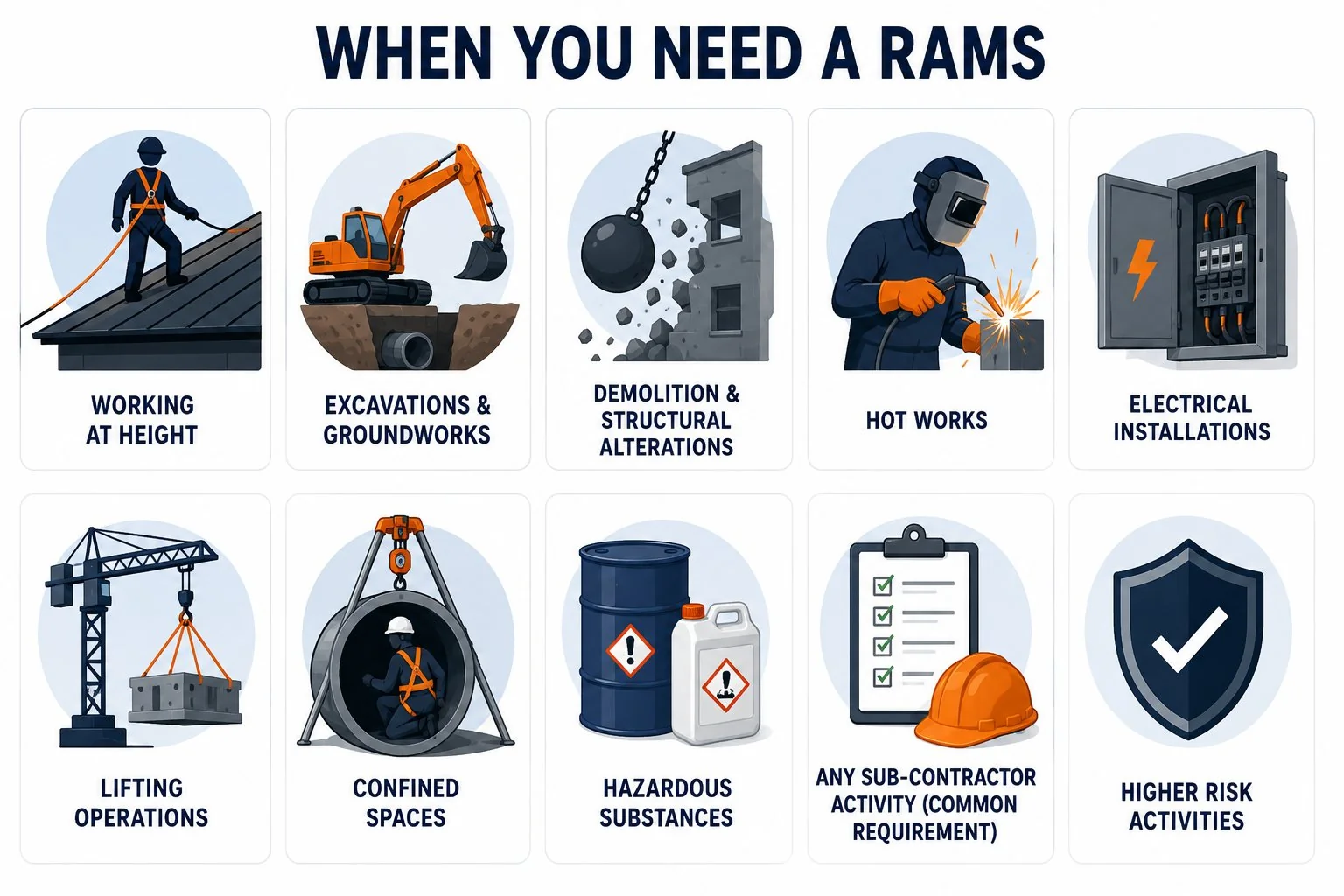
A RAMS is expected — by clients, principal contractors and insurers — for higher-risk activities. The most common categories are:
Working at height — roof work, scaffolding, mobile elevating work platforms, edge work, work near fragile surfaces.
Excavations and groundworks — anything involving ground stability, services strikes, confined spaces below ground level.
Demolition and structural alterations — load paths, dust suppression, asbestos surveys, debris management.
Hot works — welding, cutting, grinding, brazing, any task that produces sparks or heat where flammable materials are present.
Electrical work — including domestic work where relevant — requiring safe isolation or other controls. Work on or near live conductors needs specific justification and precautions; it is not a routine default.
Lifting operations — crane work, telehandlers, complex rigging.
Confined spaces — vessels, ducts, sewers, voids.
Work involving hazardous substances — where the COSHH controls need to be set out in operational detail.
Principal contractors will often require RAMS for any sub-contractor activity regardless of category, because a consistent documentation requirement is easier to administer than case-by-case judgement. That’s a procurement choice, not a legal one.
How CDM 2015 fits in
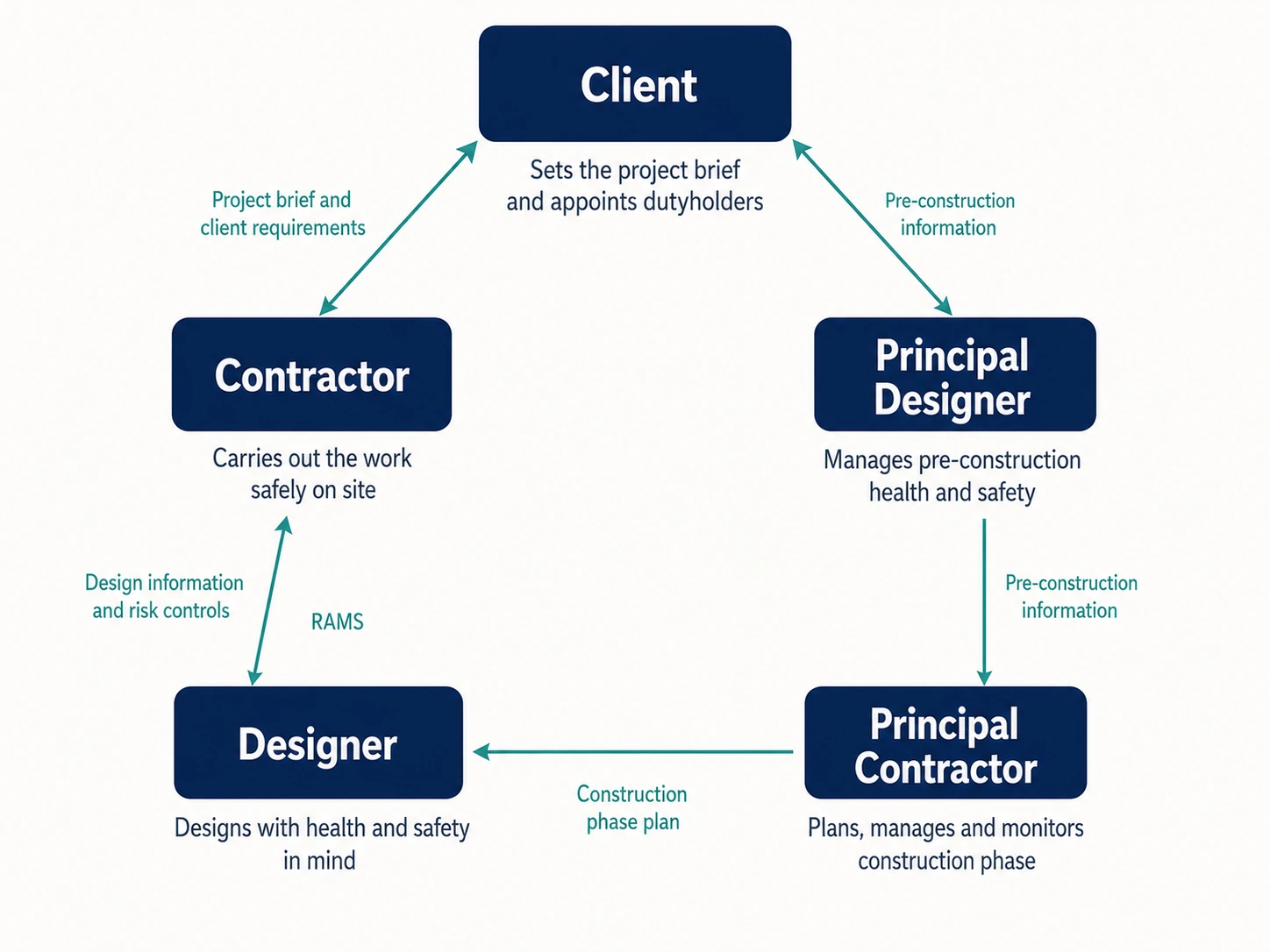
CDM 2015 applies in Great Britain; Northern Ireland has separate construction regulations. It sets duties for clients, designers and contractors, with principal designers and principal contractors required for projects involving more than one contractor.
Risk assessment under CDM 2015 starts at the design stage. The Principal Designer has a duty to identify and reduce foreseeable risks during design, before construction begins. The information then flows into the Pre-Construction Information that the Principal Contractor uses to plan the build. The Construction Phase Plan documents how the project will be managed safely, and individual RAMS for specific activities sit inside that broader plan.
The principal contractor coordinates the construction phase, while each contractor must plan, manage and monitor its own work and cooperate with others. A project may use a RAMS submission and review process, but the duties are not reduced to approving a form.
What goes in a RAMS
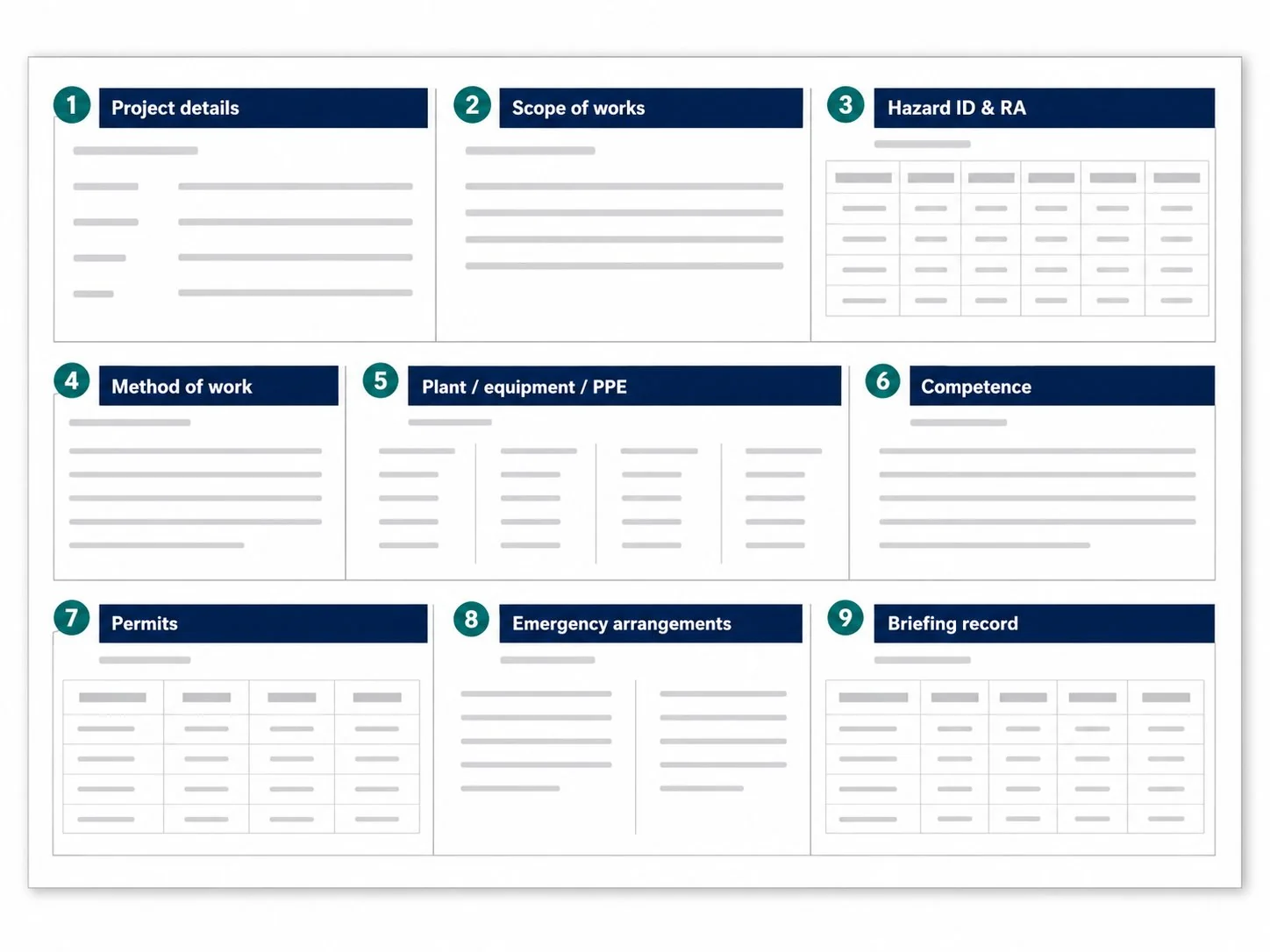
The structure varies between organisations but the core content is consistent.
Project details
Site address, client, principal contractor, contractor, date, version, who wrote it, who approved it.
Scope of works
A description of the job in enough detail that a reader unfamiliar with the project understands what’s being done.
Hazard identification and risk assessment
The hazards specific to this scope, who could be harmed, the controls that will be in place, the residual risk after controls. This is the risk assessment part.
Method of work
Step by step. Setup, sequence, supervision, equipment, materials, PPE, emergency arrangements. This is the method statement part.
Plant, equipment and PPE
What gear will be on site and any inspection or maintenance arrangements.
Competence requirements
What qualifications, training or experience the people doing the work need to have.
Permits and notifications
Any permit-to-work, hot work permit, confined space entry, or notifications required.
Emergency arrangements
First aid, fire, what happens if a worker is injured at height, escape routes.
Sign-off and briefing
Who’s accepted the document on the contractor side, who’s authorised it on the principal contractor side, and the record of the on-site briefing to the workers actually doing the job.
Who writes a RAMS and who signs it off
The contractor responsible for the work writes the RAMS. That can be in-house, or it can be drafted by a specialist consultant working for the contractor. The key requirement is that the author is competent — they have the skills, knowledge, experience and training to understand the work and the hazards.
Where the project uses a RAMS review process, the principal contractor checks how the proposed work fits the site and other activities. Acceptance does not transfer the contractor’s responsibilities or replace the principal contractor’s own coordination duties.
Workers need information and instruction they can understand before work starts, including relevant risks, controls and changes. A signed briefing record can document communication, but a signature alone does not prove understanding or safe implementation.
A worked roofing example
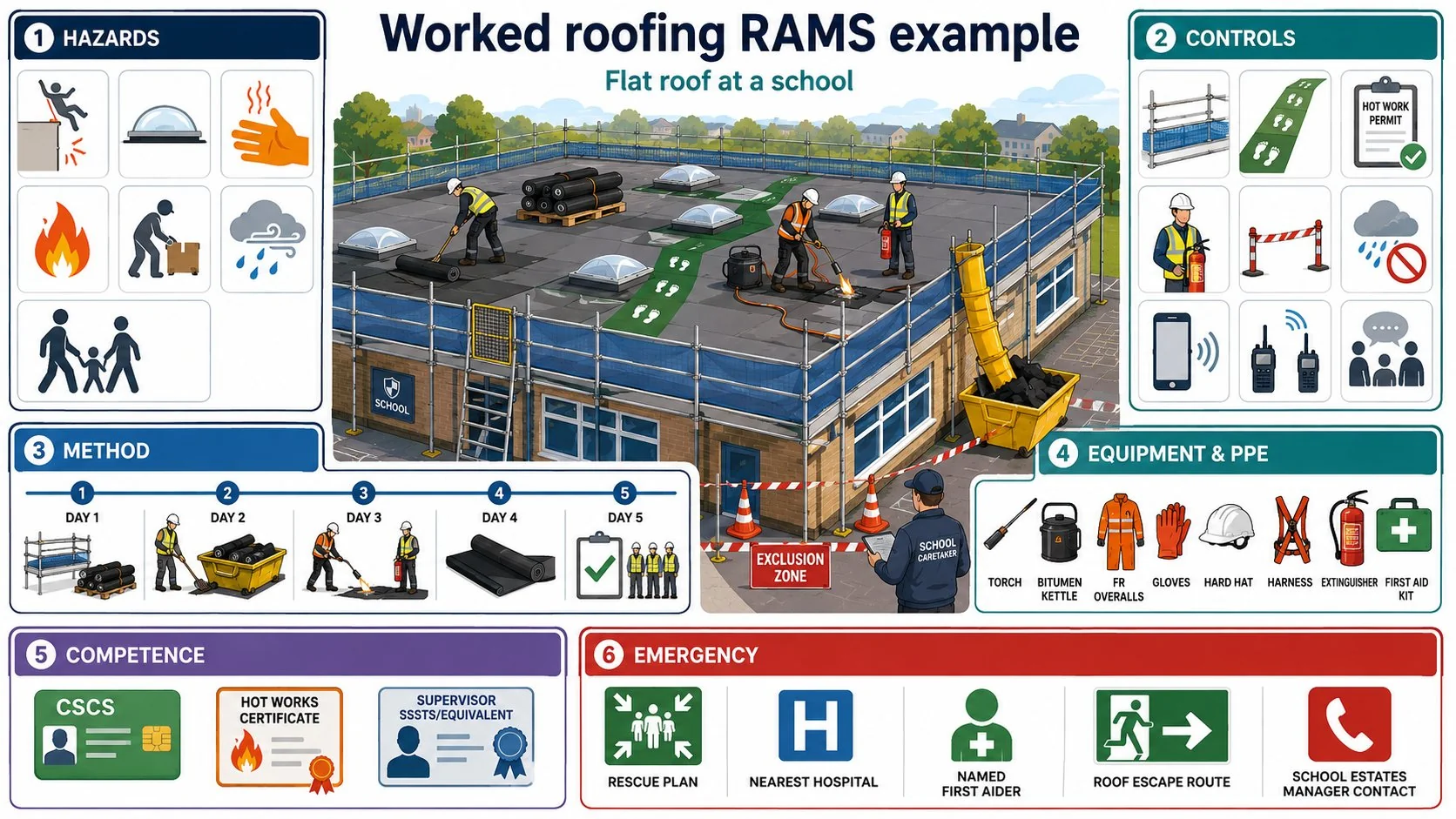
Illustrative example: a contractor plans to replace a school’s flat-roof covering. The method should first consider avoiding work at height and hot work where reasonably practicable. The points below are prompts, not a complete specification or a safe system ready for use.
The RAMS would cover:
Hazards: falls from the roof edge; falls through fragile rooflights; burns from the hot bitumen; fire spread to the building; manual handling of materials up to the roof; weather (wind, rain); members of the public on site (school staff present despite holiday).
Controls: edge protection scaffold around the perimeter; protected route across the roof avoiding rooflights; fire watch during and after hot works; written hot work permit; defined exclusion zone below; weather decision criteria (work stops at wind above a defined speed, or if surface is wet); communication plan with school caretaker.
Method: day-by-day sequence. Day 1 — scaffold up, materials delivered, hot work permit raised, area cordoned. Day 2 — strip old felt to skip via chute. Day 3 — bitumen application with two-person team, fire watch in place. Day 4 — second pass and finishing. Day 5 — strike scaffold, clear site, brief school staff on completion.
Equipment and PPE: specify suitable access and collective fall protection, safe equipment for the chosen roofing method, necessary protective clothing and appropriate firefighting provision. Do not add ad hoc harness use for reaching over an edge; any personal fall-protection system needs designed anchors, compatibility, training and rescue arrangements.
Competence: check the team’s skills, knowledge, training and experience for the method, equipment and risks. A client may require CSCS or other cards, but these are not universal statutory licences for all construction work.
Emergency: rescue plan for height work, hospital location, named first aider, fire evacuation route from roof, contact for the school estates manager.
The document should be as detailed as the work requires, without an arbitrary page target. Check and communicate the method before work begins, including coordination with the school and other contractors.
Generic templates vs site-specific RAMS
A persistent issue with RAMS is the use of generic templates that aren’t adapted to the specific site. A roofing template that mentions "edge protection" without specifying the actual scaffold design, "weather criteria" without specifying the wind speed, or "fire watch" without naming the responsible person isn’t a useful RAMS — it’s a draft that hasn’t been finished.
The HSE has consistently said in enforcement cases that generic documentation doesn’t satisfy the suitable-and-sufficient test. A template is a starting point; the work of producing a defensible RAMS is in making it specific to the site, the team, the equipment and the conditions on the day.
Adapt templates to the site and task. Identify how controls will work, who is responsible and what conditions require work to stop. The necessary detail depends on the risks; no universal checklist of names or numeric weather thresholds determines whether every RAMS is suitable.
Briefing, not filing
A signed RAMS in a folder doesn’t protect anyone. The document only does its job once the people on the ground have been briefed on it, understand it, and have the chance to question or amend it before work starts.
Briefing records can help track what was communicated and when. Check that the people doing the work understand the controls and can raise concerns; the record supports, rather than substitutes for, effective instruction.
If competence is the foundation of the RAMS being written well, the briefing is the foundation of it being followed. The two together — proper drafting and proper briefing — are what makes the document worth the time it took to produce. Well-structured Risk Assessment Training covers both elements and produces people who can do the work in-house rather than outsourcing every RAMS.
Frequently asked questions
Is a RAMS a legal requirement under UK law?
A combined document called “RAMS” is not a universal legal requirement. Risk assessment and planning duties apply under the relevant legislation, and certain activities have specific written planning requirements. A method statement can explain the safe system and may also be required contractually.
Who can write a RAMS?
Anyone competent for the work. Competence here means the skills, knowledge, experience and training to understand the hazards and the realistic controls. For straightforward work, an experienced site supervisor with the right training writes the RAMS for their own team. For complex projects, the work is often drafted by a specialist H&S consultant or an in-house H&S advisor.
How often does a RAMS need to be reviewed?
RAMS are usually job-specific and don’t have a periodic review cycle. The review trigger is change: a new site, a change of method, an incident, a near-miss, weather conditions outside the plan, or a complaint from a worker on the ground. A live RAMS on a long project is amended as needed; a one-off RAMS for a short job is closed out at completion.
What’s the difference between a method statement and a safe system of work?
A method statement is the document that describes how the work will be done. A safe system of work is the broader concept — the whole set of planning, supervision, equipment, training and procedures that produces a safe outcome. The method statement is one expression of the safe system of work; the actual safe operation requires the system to be followed in practice, not just documented on paper.
Related guides
- How often should a risk assessment be reviewed?
- Who can carry out a risk assessment? The competence question explained
- Risk assessment examples: three worked examples for UK workplaces
Sources & references
- HSE — CDM 2015 duties
- HSE — Managing health and safety in construction
- HSE — Roof work
- Management Regulations, regulation 3
Make sure your team can write and brief a site-specific risk assessment with confidence.
Explore the Risk Assessment Training course →
Mark writes about workplace health & safety, risk assessment and accredited online training for Risk Assessment Training, part of Online CPD Academy.