

A pregnancy risk assessment considers workplace hazards for a pregnant worker, someone who has given birth in the previous six months, or someone breastfeeding. In Great Britain, the Management of Health and Safety at Work Regulations 1999 sit alongside employment and equality protections. The individual’s work, health and medical advice must inform the precautions.
This page sets out the trigger for the duty, the framework for the assessment itself, the hazards that most commonly require attention, and the adjustment hierarchy employers are expected to follow when controls aren’t enough.
When the duty triggers
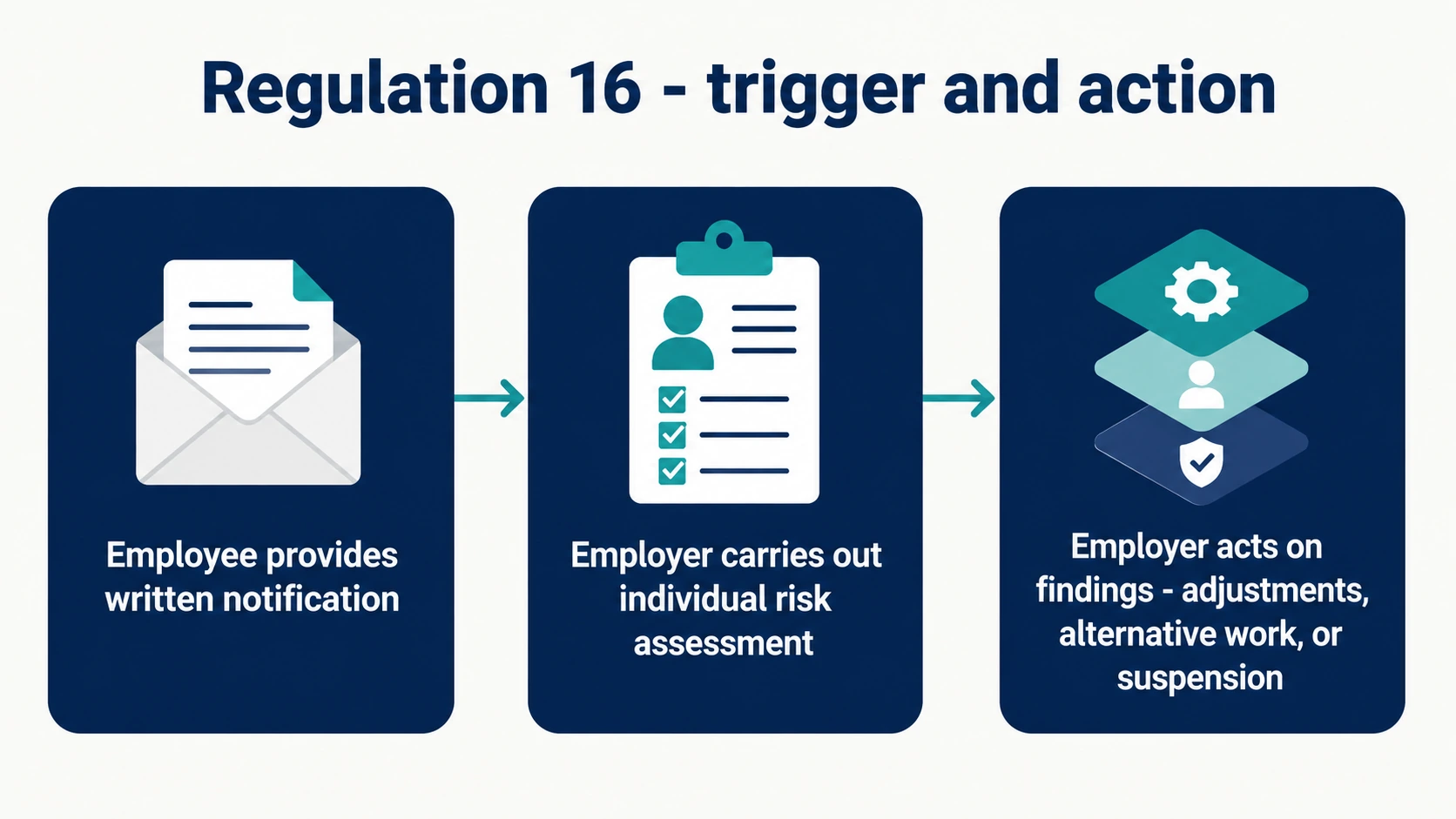
Two conditions need to be met. First, the role must be one in which work could involve risk to the health and safety of a pregnant worker, a new mother or a breastfeeding mother. The regulations are broad about what counts: physical agents, biological agents, chemical agents, processes and working conditions are all in scope. Second, the worker must notify the employer in writing that she is pregnant, has given birth in the previous six months, or is breastfeeding.
The notification mechanism matters. Until the employee tells the employer in writing, the regulation 16 duty hasn’t been triggered for that specific individual. The general workplace risk assessment must already have considered pregnancy as a foreseeable issue — that’s what regulation 3 requires — but the individual assessment under regulation 16 is triggered by the written notification.
In practice most employers ask for written notification (usually via HR) when a worker informs them of pregnancy. Some accept a copy of the MAT B1 maternity certificate; some have their own form. The format doesn’t matter — what matters is that the employer can demonstrate when notification was received, because the regulation 16 duty runs from that date.
Once the written notification is in place, the employer is required to consider the risks specific to the worker and to act on whatever the assessment identifies.
The legal framework, end to end
Regulation 16 of the Management of Health and Safety at Work Regulations 1999 is the central duty. It requires the employer to take account, in the general risk assessment, of the specific risks to new and expectant mothers; and where those risks cannot be avoided through preventive measures or adjustments to working conditions, to follow a defined hierarchy of further action.
Regulation 17 concerns suspension from night work where a medical certificate establishes that this is necessary for the worker’s health or safety. HSE advises offering suitable alternative day work and, where that is not possible, paid suspension.
Regulation 18 sets out the written-notification provisions and related certificate requirements. The employer’s general duties to assess risks and provide information also apply; regulations 17 and 18 are not interchangeable.
The Equality Act 2010 protects pregnancy and maternity as one of nine protected characteristics. The protection runs from the start of pregnancy to the end of statutory maternity leave (or the end of the protected period if the worker isn’t entitled to maternity leave). Treating a worker unfavourably because of pregnancy or maternity is direct discrimination, and there’s no comparator requirement — the worker doesn’t need to show how a non-pregnant person would have been treated. Failure to carry out an adequate pregnancy risk assessment, or failure to act on its findings, has been treated by tribunals as a form of pregnancy and maternity discrimination on top of any health and safety breach.
For specific employment-rights elements — paid time off for antenatal appointments, the right to return to the same job after ordinary maternity leave, the protection against detriment and dismissal — the Maternity and Parental Leave etc. Regulations 1999 and the Employment Rights Act 1996 provide the framework.
Pregnancy-specific hazards
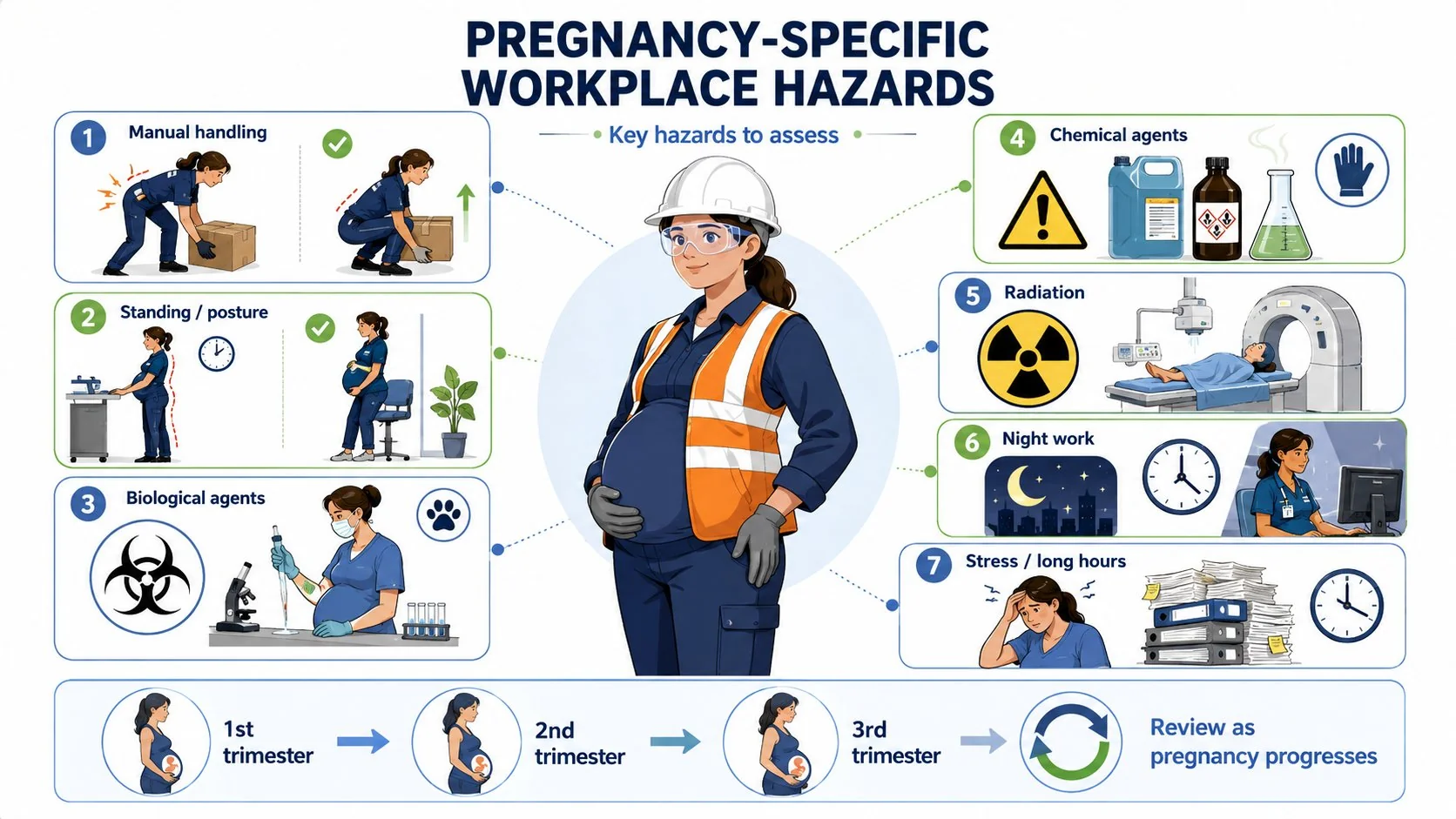
The hazards that most often require attention in a pregnancy risk assessment fall into seven categories.
Manual handling
Handling demands, fatigue, balance and reach may change during pregnancy and after birth. Assess the actual task and individual, taking medical advice into account. Avoid or reduce hazardous handling and consider suitable alternative duties where necessary.
Prolonged standing or awkward postures
Prolonged standing, awkward postures and limited opportunities to rest can be relevant risks. Discuss the worker’s needs and consider seating, rest breaks and changes to tasks or hours as appropriate.
Biological agents
Workers in healthcare, laboratory, veterinary, education, agricultural and waste-handling roles may be exposed to biological agents that pose specific risks during pregnancy — rubella, toxoplasmosis, listeria, parvovirus B19, varicella-zoster, hepatitis B, certain herpesviruses, and others. The COSHH framework covers biological agents, but pregnancy substantially changes the risk assessment.
Chemical agents
Some chemicals can harm the worker, developing child or breastfed infant. Review the substances, exposure routes and safety information, with specialist advice where needed. Do not assume that additional PPE alone makes exposure acceptable; remove or control the risk and follow the adjustment hierarchy if that is not possible.
Ionising and non-ionising radiation
Work with ionising radiation requires specific consideration under the Ionising Radiations Regulations 2017. After notification, working conditions must keep the dose to the fetus as low as reasonably practicable and unlikely to exceed 1 mSv for the remainder of the pregnancy. Obtain appropriate radiation-protection advice; non-ionising radiation requires its own relevant assessment.
Night work and shift patterns
Night work is not automatically prohibited during pregnancy. Offer suitable alternative day work where the assessment identifies a risk or medical certification says night work should be avoided; if suitable day work is unavailable, paid suspension may be necessary.
Stress and excessive working hours
Assess workload, hours, stress and risks of violence or aggression in the individual’s circumstances. Discuss concerns and medical recommendations, and make adjustments where needed to protect the worker and child.
Review the assessment regularly as pregnancy progresses and when the work or relevant circumstances change. Do not assume a task is safe solely because a particular trimester has not yet been reached.
The individual assessment in practice
Complete the individual assessment promptly after written notification and act on risks without delay. There is no universal allowance of a few working days during which unsafe exposure can continue. Involve the worker and take account of advice from their doctor or midwife.
The conversation matters. A regulation 16 assessment carried out without speaking to the pregnant worker is unlikely to identify the real issues, because pregnancy-specific concerns vary substantially between workers and between pregnancies. A first-time pregnant worker may not yet know what will become difficult; a worker on her second or third pregnancy often has very specific information about which aspects of the role she expects to need adjusted.
The output of the assessment should record the hazards identified, the conclusions about whether the existing controls are sufficient, the adjustments that have been made, and any further action required. The worker should be given a copy or be involved in agreeing the outcome.
The adjustment hierarchy
Regulation 16 sets out a specific hierarchy of further action when ordinary preventive measures and adjustments to working conditions aren’t enough to remove the risk.
Step one — temporarily adjust her working conditions or hours of work
This is the default. Modified duties within the same role, reduced hours, additional breaks, eliminated tasks, equipment changes, modified shift patterns, or adjusted workstation. The aim is to allow the worker to continue her usual role with adjustments that remove the specific risks.
Step two — if it is not reasonable to adjust the conditions, offer suitable alternative work
Where the role itself can’t be made safe, the employer must offer alternative work that the worker can do safely and that is suitable for her. Suitable means appropriate to her skills, qualifications and circumstances — not a demotion or punitive reassignment. The alternative work must be on terms and conditions no less favourable than her usual role.
Step three — if no suitable alternative is available, suspend her from work on full pay
Suspension on maternity grounds protects the worker and child when risks cannot be avoided through adjustments or suitable alternative work. It should last only as long as necessary, with pay and employment rights addressed under the applicable rules; it is distinct from sickness absence and maternity leave.
The order is mandatory. An employer who jumps to suspension when adjustments would have allowed the worker to continue is on weak ground; so is one who refuses to consider alternative work and instead requires the pregnant worker to take unpaid leave.
Breastfeeding and the return to work
The duty doesn’t end at birth. Regulation 16 continues to apply to new mothers — defined as workers who have given birth within the previous six months — and to breastfeeding mothers for as long as breastfeeding continues.
The hazards relevant to breastfeeding mothers overlap with but aren’t identical to those relevant during pregnancy. Some chemical and biological agents that aren’t a concern during pregnancy become concerns for breastfeeding because of transfer through breast milk. Manual handling remains relevant in the early postnatal period. Night work and shift patterns may need ongoing adjustment.
Employers are also required to provide somewhere for new and expectant mothers to rest (Workplace (Health, Safety and Welfare) Regulations 1992, regulation 25). In practice this often extends to providing a private space for expressing milk, although this is good practice and accepted custom rather than a specific legal requirement under those regulations.
Where this connects in the cluster
Pregnancy assessment can overlap with handling, hazardous substances, DSE, stress, night work and other risks. The relevant combination depends on the individual role; no single hazard is necessarily the main concern for every worker.
The general workplace assessment under regulation 3 should have anticipated pregnancy as a foreseeable issue before any specific worker tells you she’s pregnant. The regulation 16 individual assessment is the specific one triggered by notification.
For HR teams and line managers who handle pregnancy notifications regularly, building competence in pregnancy risk assessment pays off in both compliance and in reducing tribunal exposure. Formal Risk Assessment Training covers the general method that underpins regulation 16 work, and Maternity Action publishes free guidance for managers and workers on the legal framework.
Frequently asked questions
When do I have to tell my employer I’m pregnant?
For maternity leave arrangements, tell your employer by the required notification deadline, normally at least fifteen weeks before the expected week of childbirth, or as soon as reasonably practicable if that is not possible. For workplace safety, notify them in writing promptly so the individual assessment and necessary adjustments can be made.
What if my job is unsafe during pregnancy?
Your employer must follow the adjustment hierarchy: first adjust your working conditions or hours; if that isn’t reasonable, offer you suitable alternative work; if no suitable alternative is available, suspend you from work on full pay. You should not be required to do work that the assessment identifies as unsafe, and you should not lose pay as a result of necessary adjustments.
What is suspension on maternity grounds?
It is suspension to protect health and safety when workplace risks cannot be controlled, conditions or hours cannot be suitably adjusted and suitable alternative work is unavailable. HSE advises full-pay suspension for as long as necessary; it should not be treated as ordinary sick leave.
Does the duty extend to breastfeeding mothers?
Yes. The assessment covers pregnancy, the six months following birth and breastfeeding. Review the actual exposures and circumstances; breastfeeding can create different risks, so the pregnancy assessment should not simply be reused unchanged.
Can my employer make me take maternity leave early?
An employer should not use early maternity leave to avoid making necessary safety adjustments or arranging maternity suspension. However, leave starts automatically after an early birth or pregnancy-related sickness absence in the four weeks before the expected week of childbirth, under the statutory rules.
Related guides
- How often should a risk assessment be reviewed?
- Who can carry out a risk assessment? The competence question explained
- Risk assessment examples: three worked examples for UK workplaces
Sources & references
- HSE — Individual assessment and adjustment hierarchy
- HSE — Night work during pregnancy and after birth
- HSE — Common risks to pregnant workers and new mothers
- Management Regulations 1999, regulations 16–18
- Ionising Radiations Regulations 2017, regulation 9
- GOV.UK — Pregnant employees’ rights
- GOV.UK — When maternity leave starts
Make sure your managers and HR team are trained to carry out a clear, defensible risk assessment.
Explore the Risk Assessment Training course →
Mark writes about workplace health & safety, risk assessment and accredited online training for Risk Assessment Training, part of Online CPD Academy.