
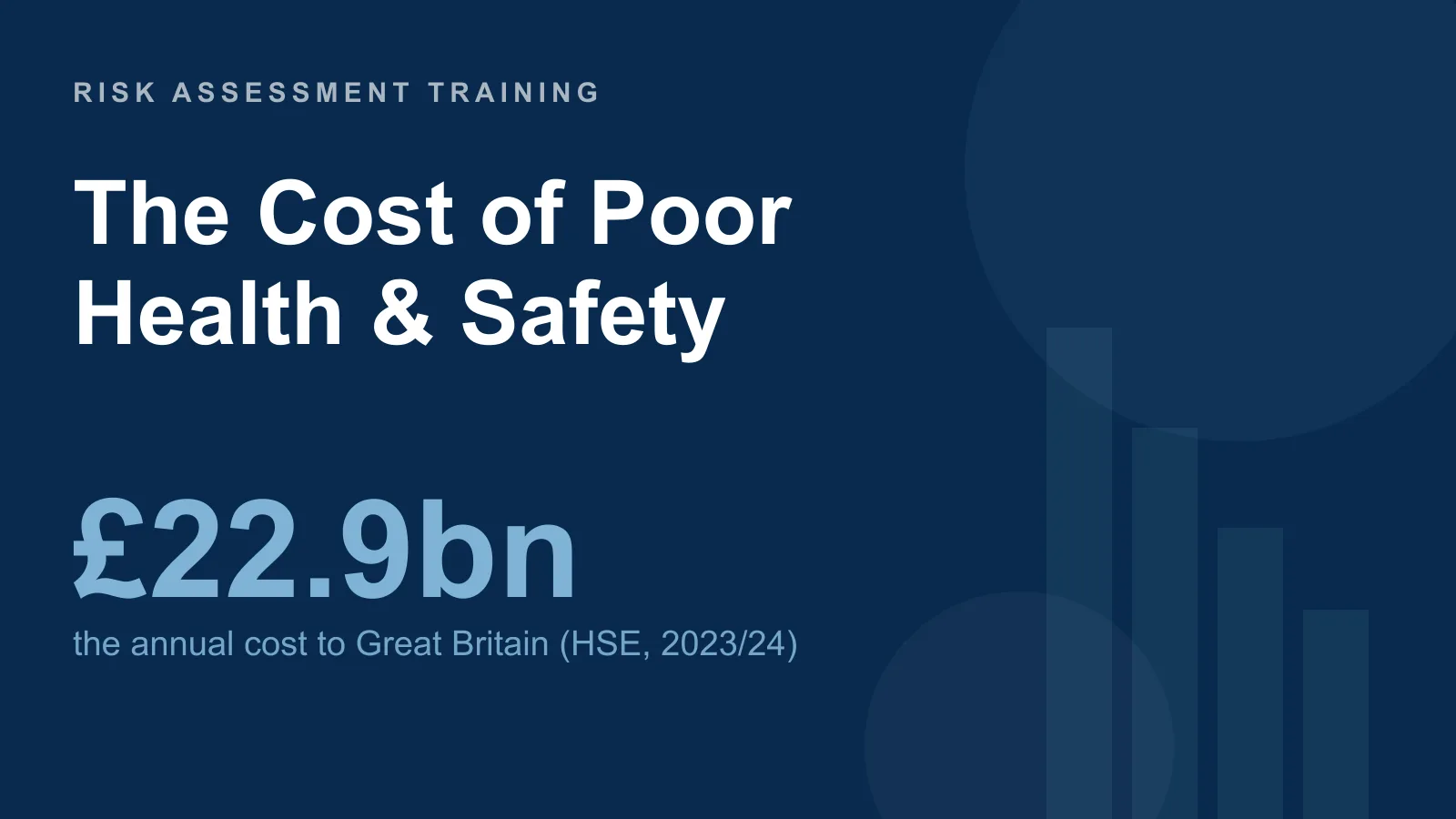
Workplace injuries and new cases of work-related ill health cost Great Britain an estimated £22.9 billion in HSE’s 2023/24 model. That total includes financial costs and a value for harm to people; it is not simply a bill paid by employers. This page explains the distinction between societal costs, employers’ costs, sickness absence and enforcement.
The numbers here come from the HSE’s Costs to Britain estimates and annual statistics for Great Britain, the HSE Annual Report and Accounts 2024/25, the CIPD Health and Wellbeing at Work survey, and IPPR’s research on the cost of employee sickness. Every figure is linked to its source at the end of the page, and each one is dated so you can see exactly which period it covers.
Key facts and figures
- £22.9 billion — estimated costs of workplace injuries and new cases of work-related ill health in Great Britain, HSE’s 2023/24 model.
- £4.3 billion — the share of HSE’s 2023/24 injury and ill-health costs borne by employers.
- £13.4 billion — the share borne by individuals, including the valuation of human costs, in HSE’s 2023/24 model.
- £10,000 & £24,200 — the HSE’s unit costs per case in 2023/24: around £10,000 per injury and £24,200 per case of ill health.
- 9.4 days — average annual absence per employee among organisations in CIPD’s 2025 survey, compared with 7.8 days in its 2023 survey.
- £30 billion — IPPR’s estimated increase in the annual cost of employee sickness to UK businesses between 2018 and 2023.
- £33 million+ — fines secured across 246 completed HSE prosecutions in 2024/25, a 96% conviction rate (HSE Annual Report).
- 40.1 million — working days lost to work-related ill health and injury in Great Britain in 2024/25 (HSE).
Reviewed on 15 October 2026. HSE’s cost model relates to 2023/24 and its latest ill-health and days-lost estimates to 2024/25. CIPD’s latest health and wellbeing employer survey is the 2025 biennial report; IPPR’s cost estimate below is historical 2023 research data.
How much does poor health and safety cost UK businesses each year?
HSE estimates £22.9 billion in costs arising from workplace injuries and new cases of work-related ill health in Great Britain in its 2023/24 model. It combines financial costs, including lost production and healthcare, with a monetary valuation of pain, grief and suffering. It excludes the continuing costs of pre-existing ill-health cases from the headline new-case estimate.
Ill health accounts for £16.4 billion and injury for £6.5 billion. Across the combined total, individuals bear £13.4 billion, employers £4.3 billion and government £5.2 billion. These are different ways of dividing the same £22.9 billion; the amounts should not be added together again. Our sister site’s cost of workplace injuries guide discusses the model further.
What are the “uninsured” or hidden costs of a workplace accident?
Insurance can cover some consequences of an incident, subject to the policy, limits and exclusions. It does not remove the employer’s duties to prevent harm, and an insurance payout is not a measure of the incident’s full financial or human cost.
Costs that may remain with the employer include absence cover, disruption, management time, damaged materials and recruitment. Their size varies with the incident and business. A fixed uninsured-to-insured ratio or a standard annual cost per employee should not be treated as a current forecast for every firm.
| Costs that may be insured, subject to cover | Other potential business costs |
|---|---|
| Employers’ liability compensation | Sick pay and cover for absent staff |
| Damage to buildings and plant | Lost production and stopped output |
| Public and product liability claims | Damaged product, tools and materials |
| A share of immediate response costs | Overtime, recruitment and retraining |
| — | Investigation, management and admin time |
| — | Higher premiums and lost business reputation |
When estimating an incident’s cost, identify the actual losses, check the insurance terms and avoid counting the same loss twice. The purpose of a risk assessment is to prevent and control harm; a generic cost multiplier cannot replace that assessment.
How much does workplace injury and ill health cost per employee?
HSE reports average unit costs of approximately £10,000 per injury case and £24,200 per new ill-health case for 2023/24. These are societal estimates across cases of different severity, not a price per employee or a compensation tariff. They cannot predict what a particular incident will cost an employer.
Ill-health cases result in more time off work on average in HSE’s model, but outcomes vary substantially. HSE estimated 35.7 million days lost to work-related ill health and 4.4 million to non-fatal injury in 2024/25. Across both, the mean was 16.4 days per case; for stress, depression or anxiety it was 22.9 days, and for musculoskeletal disorders 14.0 days.
| Cost metric | Figure | Data period |
|---|---|---|
| HSE unit cost per injury case | ~£10,000 | 2023/24 |
| HSE unit cost per ill-health case | ~£24,200 | 2023/24 |
| Costs borne by employers | £4.3 billion | 2023/24, total injury and new ill health |
| Days lost to work-related ill health and injury | 40.1 million | Great Britain, 2024/25 |
| Average days lost per case | 16.4 days | 2024/25 |
| Average days lost per stress case | 22.9 days | 2024/25 |
How much does sickness absence cost employers?
CIPD’s 2025 employer survey reported an average 9.4 days of absence per employee annually, compared with 7.8 in its 2023 survey. This includes illness unrelated to work and describes the responding organisations. It differs in coverage and method from the ONS Labour Force Survey estimate of 4.4 days per worker for the UK in 2025.
Absence varies by sector and workforce. Comparisons should use a consistent measure and population: an employer-survey mean, the ONS percentage of working hours lost and an NHS percentage of available days lost are not interchangeable. Local absence records can help employers identify work-related risks without assuming that all sickness was caused by work.
HSE estimated 964,000 workers with work-related stress, depression or anxiety in Great Britain in 2024/25, accounting for 22.1 million days lost. The work-related stress statistics guide explains these estimates and the employer’s assessment duty.
What is presenteeism costing employers?
IPPR’s 2024 analysis estimated that the annual cost of employee sickness to UK businesses had increased by £30 billion between 2018 and 2023. It attributed around £25 billion of that increase to lost productivity while working through sickness and £5 billion to additional sickness absence. These are modelled historical productivity losses, not an HSE estimate of work-caused illness.
IPPR estimated that employees lost the equivalent of 44 days of productivity through working while sick in 2023, compared with 35 days in 2018. This is modelled lost output, not 44 additional recorded absence days. The estimate uses survey-based productivity impairment and wage values, so its method and scope differ from official sickness-absence measures.
| Sickness-cost measure | Figure | Data period |
|---|---|---|
| Modelled sickness absence days per employee | 6.7 days | 2023, IPPR analysis |
| Increase since 2018 | +£30 billion | 2018–2023 |
| Share of increase from presenteeism | ~£25 billion | 2018–2023 |
| Share of increase from extra sick days | ~£5 billion | 2018–2023 |
| Productivity days lost to presenteeism | 44 days | 2023 (35 in 2018) |
How much do health and safety fines and enforcement cost?
HSE’s 2024/25 annual accounts report 246 completed prosecutions, a 96% conviction rate and fines exceeding £33 million. Those rounded totals do not provide a reliable typical fine. In England and Wales, the sentencing guideline considers culpability, harm and turnover, and Crown Court fines can be unlimited.
Prosecution costs and other business losses can arise in addition to a fine. Where HSE’s Fee for Intervention scheme applies, the rate is £188 per hour from 1 April 2026. The 2024/25 accounts also report more than 4,400 enforcement notices. See our HSE enforcement statistics for the distinctions between charges, notices and prosecutions.
How can prevention reduce the costs of harm?
Preventing harm can avoid disruption, financial loss and suffering that insurance cannot fully address. The cost and effectiveness of a control depend on the hazard and workplace; no fixed ratio establishes that every proposed intervention will save money.
A suitable and sufficient assessment identifies hazards, the people at risk and the controls needed. Implementing and reviewing those controls is essential: a completed form alone does not prevent an incident or guarantee freedom from enforcement. Employers should address legal duties and reasonably practicable precautions, rather than use a generic financial return as the sole test.
Frequently asked questions
How much does poor health and safety cost UK businesses each year?
HSE’s 2023/24 model estimates £22.9 billion in costs to Great Britain from workplace injuries and new work-related ill-health cases. Employers bear about £4.3 billion; the remainder falls on individuals and government. The societal total is not an employer-only loss estimate.
What are the “uninsured” or hidden costs of a workplace accident?
They are losses not met by the relevant insurance policy, which may include staff cover, production disruption, investigation time or damaged materials. Actual cover and losses vary; there is no single current multiplier that reliably predicts every employer’s uninsured bill.
How much does workplace injury and ill health cost per employee?
HSE’s approximate £10,000 injury and £24,200 new ill-health unit costs for 2023/24 are per case, not per employee. They include societal and human costs and should not be used as a fixed annual charge for each member of staff.
How much sickness absence does the average UK employee take?
The ONS estimated 4.4 sickness absence days per UK worker in 2025. CIPD’s separate 2025 employer survey reported 9.4 days per employee among responding organisations. Different populations and methods mean these are not directly interchangeable.
How can prevention reduce the costs of harm?
Effective controls can prevent harm and avoid disruption and loss, but the financial return varies. Employers must meet their legal duties and select proportionate precautions; insurance or a generic savings estimate is not a substitute for controlling risks.
Related guides
- HSE Enforcement Statistics UK: Fines, Prosecutions & Notices
- Risk Assessment Statistics UK: Compliance Facts & Data
- Work-Related Stress Statistics UK: HSE Facts & Data
- What is a risk assessment? A guide to UK workplace law
- The 5 steps to risk assessment: how to do one properly
Sources & references
- HSE — Costs to Britain and unit costs, 2023/24
- HSE — Health and safety statistics for Great Britain
- HSE — Working days lost, 2024/25
- HSE — Annual report and accounts 2024/25
- HSE — Fee for Intervention hourly rates
- CIPD — Health and wellbeing at work 2025
- ONS — Sickness absence in the UK labour market, 2025
- IPPR — Healthy industry, prosperous economy
- HSE — Managing risks and risk assessment
- IPPR — Historical productivity-cost analysis, July 2024
The cheapest line on any safety budget is the accident that never happens. Train your team to spot and control hazards before they become a claim, a fine or a month of lost output.
Explore the Risk Assessment Training course →
Mark writes about workplace health & safety, risk assessment and accredited online training for Risk Assessment Training, part of Online CPD Academy.